UVTAB logo
National TVET assessment and certification

Trusted skills. Recognised qualifications.

Featured update

Accreditation of institutes

Apply for and manage assessment centre accreditation with UVTAB online.

View update
0+Candidates assessed annually
0+Accredited centres
0+Approved programmes
0+Years of Excellence
What We Do

Our Mandate & Services

Our Mandate

UVTAB is responsible for the Assessment and Certification of Competences obtained through Formal and Informal Technical & Vocational Education and Training and development and management of TVET curriculum and training packages. (The Technical & Vocational Education and Training Act, No.3 of 2025)

Read more

Our Services

  • Registration and assessment of candidates
  • Accreditation of assessment centers
  • Development of assessment instruments
  • Quality assurance and standards
  • Document verification and certification
  • Equating of qualifications
Explore services
Leadership

Opening Statements

Onesmus Oyesigye (CPA)

Onesmus Oyesigye (CPA)

Executive Secretary

“I am pleased to welcome you to UVTAB Website. UVTAB is a national TVET assessment body established by the TVET Act No.3 of 2025. UVTAB is responsible for the assessment and certification of competencies obtained through formal and informal TVET. The Board is responsible for the development of Assessment Training Packages and TVET curricular in consultation with the Sector Skills Expert committees, TVET providers and with approval of TVET Council....”

Assoc. Prof. Dorothy Okello

Assoc. Prof. Dorothy Okello

Board Chairperson

“On behalf of the Board of Uganda Vocational and Technical Assessment Board (UVTAB), I am pleased to welcome you to our official website. UVTAB is the national assessment body responsible for the assessment and certification of competencies obtained through both formal and informal TVET in Uganda....”

Official updates

Latest from UVTAB

News, institutional updates and stories from Uganda's vocational and technical assessment body.

View all news

Uganda to certify skills gained outside classrooms – TVET Council boss

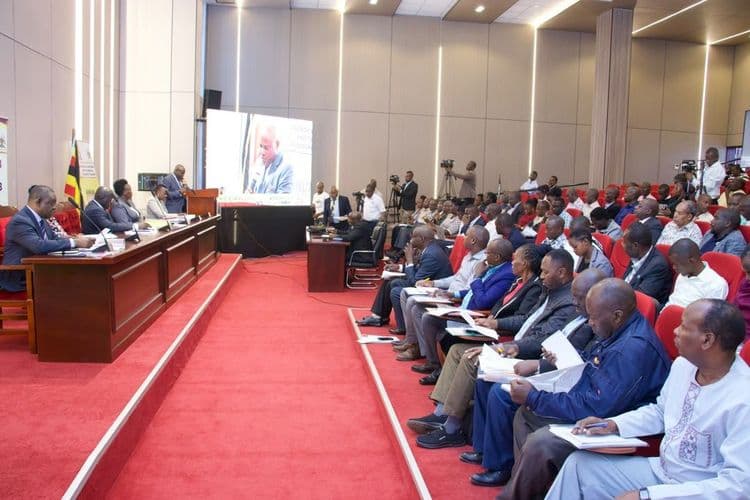
Extracted from PML Daily. 10 October 2026 | KAMPALA — Ugandans who acquire technical skills through informal work and practical experience could have their competencies formally recognised and certified under reforms being implemented by the TVET Council. Moses Kasakya, the Executive Director of the TVET Council, said the council was finalising guidelines to assess and certify people who possess occupational skills but lack formal training qualifications. Kasakya said the initiative would allow people to demonstrate their abilities against established competency standards, opening up opportunities for skilled workers who acquired their expertise outside conventional education institutions. “Education is one way to gain skills, but it is not the only way,” Kasakya said during the Uganda Vocational and Technical Assessment Board (UVTAB) Stakeholders’ Feedback Workshop 2026. He explained that applicants would not automatically receive certificates based on claims about their abilities but would have to undergo assessments to establish whether they meet the competencies required at their respective qualification levels. The proposed arrangement is part of wider reforms aimed at making technical and vocational education and training (TVET) more responsive to Uganda’s labour market and economic ambitions. Uganda targets to expand its economy from about $50 billion to $500 billion by 2040, with the government prioritising agricultural industrialisation, tourism and hospitality, mineral development and manufacturing, as well as science, technology and innovation. Kasakya said achieving the target would require not only increased production but also a workforce equipped with the practical skills needed to support growth in these sectors. “Producing more goods and services, however, will not transform the economy on its own. We also need people with the right skills to drive growth in these priority sectors,” he said. He noted that TVET had for years operated under fragmented arrangements, with training responsibilities spread across different ministries and limited coordination and oversight. The government has since consolidated the system under the Ministry of Education and Sports, with the TVET Act providing the legal framework for improved regulation, coordination and quality assurance. The Act came into effect on March 15, 2025, while the TVET Council was inaugurated in July 2025 to guide the implementation of the reforms. Kasakya said the council had established a seven-member governing body chaired by Malen Kagina, alongside a secretariat to support its operations. Another milestone is the development of the Uganda TVET Qualifications Framework, which establishes the levels at which technical and vocational qualifications are organised. Kasakya clarified that the framework had been revised to align with the broader education framework, which has eight levels. Under the revised arrangement, a diploma is placed at Level Four, unlike the initial draft that placed it at Level Five in a proposed 10-level structure. The council is also seeking to strengthen the link between training institutions and employers to address the mismatch between graduates’ qualifications and the skills demanded by the labour market. Kasakya said the council had established about 15 Sector Skills Expert Committees to identify employers’ needs and provide information to guide curriculum development and training standards. The committees cover sectors including agriculture, manufacturing, tourism, business, sports, oil and gas, and minerals. The council is also working to recognise emerging occupations, including event management and disc jockeying, as legitimate fields requiring professional skills development and recognition. Kasakya said closer collaboration between training institutions and industry was essential to creating opportunities for learners. He cited plans for students from Uganda’s technical colleges to travel to China to compete against students from other countries, with their participation supported by Chinese industries operating in Mbale. The workshop brought together TVET practitioners, trainers and other stakeholders to review progress in implementing reforms and identify areas requiring further improvement. UVTAB Executive Secretary Onesmus Oyesigye said the board was also updating stakeholders on newly developed curricula, approved Assessment and Training Packages, and regulations governing assessments, including penalties for malpractice. Oyesigye said the assessment rules had been gazetted, paving the way for their implementation, and urged institutions to familiarise themselves with the requirements. UVTAB Deputy Executive Secretary in charge of Curriculum Development and Management, Jalia Nasaza, said 17 technology programmes had been developed and approved by the TVET Council, while 12 programmes in business education and training and one in home science education and training had been submitted. She urged training institutions to align their programmes with labour-market demands and incorporate communication, entrepreneurship and teamwork skills alongside technical competencies. Education Ministry Permanent Secretary Ketty Lamaro said the reforms would only deliver results if institutions prioritised practical competence, integrity and quality training. Lamaro warned that certificates alone would not guarantee employment if graduates could not demonstrate the skills required by employers. She urged trainers to embrace continuous learning and give trainees enough opportunities to practise, saying Uganda’s economic transformation depended partly on producing graduates capable of translating knowledge into productive work.

Read story

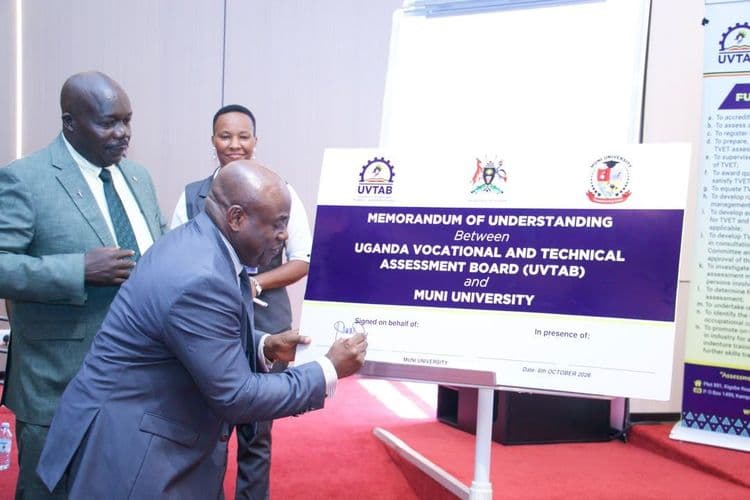
Muni University, UVTAB sign deal to expand skills certification for refugees, youth

Extracted from PML Daily. 08 October 2026 | KAMPALA – Muni University and the Uganda Vocational and Technical Assessment Board (UVTAB) have signed a Memorandum of Understanding (MoU) to expand skills assessment and certification for young people, including refugees and members of host communities in West Nile. The agreement was signed during the UVTAB Stakeholders’ Feedback Workshop 2026, with officials saying the partnership is intended to strengthen the link between vocational training, certification and employment. Under the MoU, UVTAB will work with Muni University to assess and certify employable skills acquired through the university’s Refugee and Host Community Youth Empowerment and Transformation Initiative (RETI) and other skills-development programmes. Muni University Vice Chancellor, Associate Professor Simon Anguma Katrini, said the partnership would take skills development beyond the university campus and closer to communities that have limited access to formal training and certification. “Through this memorandum of understanding, we aim to deepen our collaboration and strengthen Muni University’s community engagement through three key approaches: taking the university to communities, linking learning to earning, and using a community-based artisan model,” Anguma said. RETI, supported by the Mastercard Foundation, seeks to equip 100,000 young people, including refugees and members of host communities, with skills that can lead to dignified employment. According to Anguma, local artisans have been central to RETI’s community-based training model, but the new partnership with UVTAB will focus on improving their teaching methods, quality assurance, assessment and certification. The university also plans to work with UVTAB to establish a competence assessment centre either at its main campus or one of its satellite centres. Such a centre, Anguma said, would bring assessment and certification services closer to young people in West Nile, particularly refugees, while supporting other skills-development programmes in the region. The MoU will also facilitate collaboration on internship and apprenticeship guidelines, joint research, staff development, resource mobilisation, and sharing of facilities and expertise. UVTAB Executive Secretary Onesmus Oyesigye said the partnership provides a framework for delivering credible, transparent and nationally recognised assessment and certification services to beneficiaries of RETI and other programmes. He said UVTAB would participate in the RETI Programme Advisory Group, provide strategic guidance, help develop guidelines for internship and entrepreneurship placements, organise assessment schedules and deploy qualified assessors. “The MOU has been cleared by the Office of the Attorney General, which has confirmed that it carries no financial implications for the Government,” Oyesigye said. He called on other universities and higher education institutions to partner with UVTAB, arguing that skills development requires collaboration between government assessment bodies, universities and industry. “We cannot do this alone. Skills development in Uganda depends on strong partnerships with universities such as Muni,” Oyesigye said. Education Ministry Permanent Secretary Ketty Lamaro said the partnership comes at a time when Uganda is undertaking reforms aimed at ensuring that graduates acquire practical skills needed in the labour market. Lamaro said Uganda’s ambition of transforming into a modern and prosperous country by 2040 will depend heavily on the quality of people produced by the education system. She challenged institutions involved in technical and vocational education to embrace continuous learning and adapt to changes in the labour market. “We must all be ready to keep learning. Without that willingness, the reforms will not deliver the results we expect,” Lamaro said. She said the reforms should ultimately produce graduates who are not only academically knowledgeable but also capable of applying their skills in real-world workplaces. The Muni-UVTAB partnership therefore places assessment and certification at the centre of the transition from training to employment, particularly for young people trained through community-based and non-formal skills programmes. The officials said the collaboration is expected to provide young people with recognised proof of competence, while strengthening the contribution of local artisans and community-based training models to Uganda’s TVET system.

Read story

Education: Learn how to use artificial intelligence, TVET trainers told

Extracted from New Vision. 07 October 2026 | Technical Vocational and Education Training instructors have been urged to embrace artificial intelligence (AI) or risk being replaced by professionals who know how to use the technology. Eng. Albert Akovuku, who represents the finance ministry on the Uganda Vocational and Technical Assessment Board (UVTAB), said AI is rapidly changing the skills landscape and could make some traditional skills less relevant. Akovuku, who represented UVTAB chairperson Prof. Dorothy Okello at the board's annual stakeholders' feedback workshop in Kyambogo, Kampala on Tuesday, said instructors must learn to use AI while ensuring that it does not undermine the integrity of assessments. "AI should not replace you. But if you don't use it, those who use it will replace you," he said. Akovuku, however, warned that the growing use of AI by students could make it difficult for instructors to determine whether learners had genuinely acquired the competencies being assessed. The concern, he said, is particularly important under the TVET training model, where practical work accounts for a large proportion of assessment. "Imagine a student does his practicals, then prepares a very good report using AI. If you, the instructor, are not good at AI, then the student is bound to get 100%. But you are not assessing the student; you are assessing AI." He said the challenge also extends to theory assessments, particularly where students are allowed to take examinations home and use AI to generate answers. Some or most of the students take coursework home, and bring back very good answers where the solution is provided by AI, and you end up awarding full marks. You are assessing AI and not the student." He warned that continued reliance on conventional paper-based assessments without adapting to the growing use of AI could undermine the purpose of training and assessment. Akovuku also cautioned that AI could make some skills, such as coding, less relevant as learners increasingly turn to the technology for information, solutions and technical assistance He said the solution is not to reject AI but instead to equip instructors with the knowledge to use it responsibly while maintaining safeguards that ensure assessments measure learners' actual competencies. He recalled how Makerere University once trained professors who were unfamiliar with computers, saying a similar approach was needed as AI becomes increasingly important in education and the workplace. He urged instructors and other TVET stakeholders to learn about AI while ensuring that it supports rather than replaces human expertise. Julia Nasaza, the UVTAB deputy executive secretary in charge of curriculum, said AI can be useful to TVET learners for guidance and information but cannot replace the practical skills on which their training and assessment are based. "AI is not bad. People can use AI to get direction, get some highlights and get some information. But after getting that information, how do you use it to be productive?" She said the increasing emphasis on practical assessment means learners cannot rely on AI-generated answers to pass their assessments. Practical assessment accounts for 70% of the mark in diploma programmes while theory accounts for 30%. "If you use your AI and you get the 30%, that is not the pass mark. You will still fail," warned Nasaza. The practical component is even higher at lower TVET levels, where theory accounts for 20% and practical work 80%. The annual stakeholders' workshop was held to review progress on issues agreed upon during the previous year's meeting and identify areas requiring improvement. UVTAB also presented reforms implemented over the past year, including new curricula and Assessment and Training Packages (ATPs), while collecting proposals from trainers, practitioners and other stakeholders in a bid to create a common understanding of the reforms being implemented and encourage stakeholders to identify areas that need improvement. The board's executive secretary, Onesmus Oyesigye, said the reforms are aimed at strengthening confidence in curriculum development and management, assessment and certification, while ensuring that TVET qualifications provide meaningful opportunities for graduates and respond to the needs of the world of work. He called for greater inclusion of people who acquired skills outside the formal education system, urging Ugandans who acquired skills through formal, non-formal or informal learning to seek assessment and certification so that their competencies can be formally recognised within the TVET system. "For inclusivity, I call upon all Ugandans, irrespective of where they acquired their skills, to come forward, visit the nearest TVET provider, and register for skills assessment and certification." Oyesigye said formal recognition of such skills would help strengthen the TVET system and ensure that people who acquired competencies outside conventional training institutions can also have them assessed and certified. The stakeholders' workshop brought together trainers, practitioners and other stakeholders to review the reforms, assess progress and discuss measures for improving implementation.

Read story